- Sumário
- Comentário de William Beckford sobre a representação de Inês de Castro de Franchi (1794)
- Ano
- 1794
- Impresso
- William Beckford, Recollections of an Excursion to the Monasteries of Alcobaça and Batalha, Londres, Richard Bentley, 1835
- Menções
- Excursion à Alcobaça et Batalha, traduction, introduction et notes par André Parreux, Paris / Lisbonne, 1956; Laureano Carreira, O teatro e a censura em Portugal na segunda metade do século XVIII, Lisboa, Imprensa Nacional, 1988, p. 405
William Beckford, Recollections of an Excursion to the Monasteries of Alcobaça and Batalha, Londres, Richard Bentley, 1835
Observing a good deal of whispering and message-sending between the Priors and their confidential attendants going forward, accompanied by nods and winks, I thought something particular for our special amusement was in contemplation;
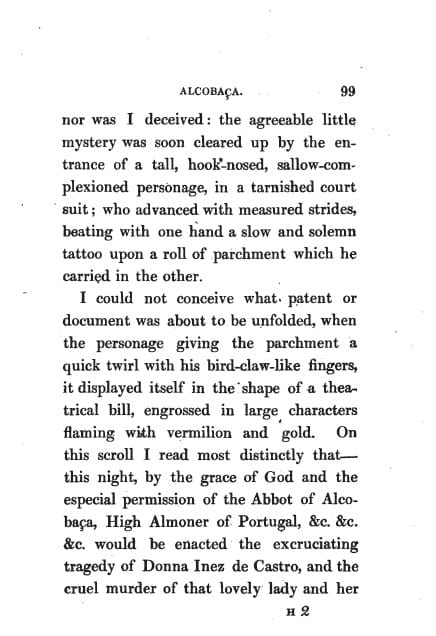
nor was I deceived: the agreeable little mystery was soon cleared up by the entrance of a tall, hook-nosed, sallow-complexioned personage, in a tarnished court suit; who advanced with measured strides, beating with one hand a slow and solemn tattoo upon a roll of parchment which he carried in the other.
I could not conceive what patent or document was about to be unfolded, when the personage giving the parchment a quick twirl with his bird-claw-like fingers, it displayed itself in the shape of a theatrical bill, engrossed in large characters flaming with vermilion and gold. On this scroll I read most distinctly that— this night, by the grace of God and the especial permission of the Abbot of Alcobaca, High Almoner of Portugal, &c. &c. &c. would be enacted the excruciating tragedy of Donna Inez de Castro, and the cruel murder of that lovely lady and her
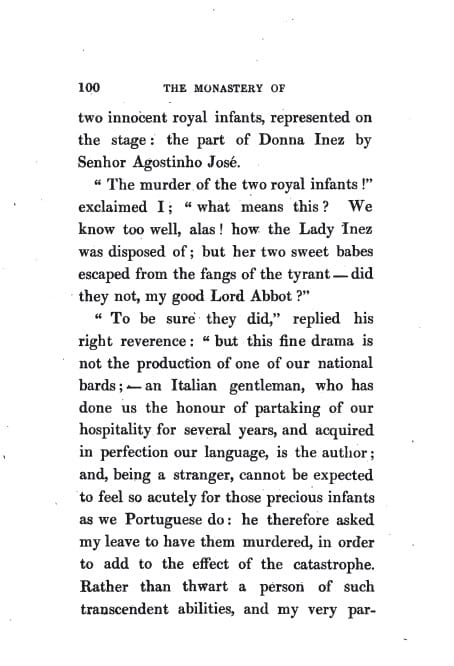
two innocent royal infants, represented on the stage: the part of Donna Inez by Senhor Agostinho José.
“The murder of the two royal infants!” exclaimed I, “what means this? We know too well, alas| how the Lady Inez was disposed of, but her two sweet babes escaped from the fangs of the tyrant – did they not, my good Lord Abbot?”
“To be sure the did”, replied his right reverence. “but this fine drama is not the production of one of our national bards – an Italian gentleman, who has done us the honour of partaking of our hospitality for several years, and acquired in perfection our language, is the author; and, being a stranger, cannot be expected to feel so acutely for those precious infants as we Portuguese do. He therefore asked my leave to have them murdered, in order to add to the effect of the catastrophe. rather than thwart a person of such transcendent abilities, and my very
particular friend, I consented. He had half a mind to make them fall by their mother's own poniard in a fit of frenzy: but I could not allow of that; it would have been stretching a little too far—do't you think so ?"
Recollecting the stretches I had often met with at home in historical novels— witness Miss Lee's " Recess" and many others—I made no objection, and turning to the bard, who was standing by wrapt into future murders, praised his sublime efforts in the tragic vein—the terribile via— in the most glowing terms I could muster. Animated by these grateful eulogies, he vociferated with dreadful vehemence, " Let me but live a few years longer, and I will be the death of half the regal personages in the Portuguese history, after my own fashion and no other. I will slay them magnificently on the battlefield, though they died in their brocaded beds with all their courtiers puling
around them; I will sink them in the ocean, though they expired on dry land ;— their agonies in the act of drowning shall be horrible ;—nay, more, I will call upon the Prince of the Morning, upon Lucifer himself, to bear them away for some secret sin or compact, though the prayers of the church had been exhausted to avert such a direful calamity."
I thought this was a stretch with a vengeance : the Abbot, I plainly saw by his countenance, was of the same opinion ; but, giving his ample shoulders a kind commiserating shrug, (for the bard was a special favourite,) contented himself with whispering to me—" Sta doedo—sta doedo; the ma's mad — all poets are."The Grand Prior of Aviz, who seemed to have no doubt of the truth of this observation in the present instance, looked at the bard with an expression of alarm that was almost ludicrous, and shrinking back in his chair, exclaimed piteously —
" What, Donna Inez and her children butchered upon the stage ? I shall never be able to stand this; my eyes would become fountains, and we have had weeping enough lately," (alluding perhaps to the liquefaction scene of last night:) " tragedies of so deep a dye as this we are promised, affect my nerves in the most painful manner". So saying, he retired without further ceremony, accompanied by two reverend fathers, dignitaries of the convent, who professed the same clerical aversion to scenes of bloodshed.
As soon as they had departed to a quiet game of voltarete in their own snug quarters, the Lord Abbot, observing it was growing late, (for we had passed a most unconscionable time at table,) invited me to repair, under his Sub-Prior's guidance, to a theatre which had been temporarily fitted up in the most distant part of this immense edifice, of the extent of which, as well as of the endless variety of its
cloistered galleries, cells, chapels, and chambers, I had not till this moment an adequate idea. Our peregrinations, therefore, were none of the shortest or least intricate. We passed through several galleries but feebly lighted, disturbing, I fear, the devotions of some aged monks, who were putting up their orisons before a lugubrious image of our Lady of the.Seven Dolours, placed under a most sumptuously fringed and furbelowed canopy of purple velvet.
Farther on, another vast corridor branched off to that part of the convent allotted to scholars and novices. Not a few of these gentle youths were pursuing the study of the Jew's harp, and twanging away most proficiently. All these scudded off upon our approach, — the whole party had been at high romps, I suspect, from their flushed and blowzy appearance, — wishing us, I dare say, in purgatory, or
a worse place, for having intruded upon their recreations.
Advancing with due gravity, the valves of a lofty architectural door, with a pompous inscription on the pediment in golden characters, were unfolded, and we entered an extraordinarily spacious, coved saloon, which appeared to have been assigned to holier purposes, for there was an organ in a recess on one side of it. Across the whole end of this apartment was extended an immense green curtain, with the insignia of the convent emblazoned upon it in vivid colours; the centre of the saloon was occupied, as might have been expected, with many a row of polished oaken benches; but what I did not expect was an assemblage of more than one hundred venerable fathers, sitting in solemn ranks, as if they had been assisting at an ecumenical council, some wiping their spectacles, and some telling their
beads. An effluvia, neither of jasmine nor roses—in short, that species of high conventual frowziness which monastic habits and garments are not a little apt to engender, affected my lay nerves most disagreeably.
The Prior of St. Vincent's, perceiving the uneasy curl up of my nose, whispered his neighbour, who whispered a second, who whispered a third, and presently a most grateful vapour of fragrant herbs and burnt lavender filled the room. Through its medium appeared descending from a portal, by a flight of most spacious steps, the Lord Abbot himself in grand costume. He insisted, with a positiveness which I could not avoid obeying, that I should take his abbatial chair next the orchestra, and placed himself on another equally ponderous, conceding the one on my right hand to the Prior of St. Vincent's.
We were no sooner settled, than halfa-dozen "sharp-toned fiddles, a growling
bass, two overgrown mandolines, (lutes I suppose I ought to style them), and a pair of flutes most nauseously tweedled upon by two wanton-looking, blear-eyed young monks, who It would be charitable to suppose had caught cold at some midnight choral service, struck up a most singular and original species of antiquated overture. It was full of jerking passages in the style of " Les Folies d'Espagne," and ended with a fugue that was catchwho-can in perfection.
Instead of the curtains drawing up at the conclusion of this strange musical farrago, there was a tedious pause, and I had full time to look round on the audience. Not five monks off my fauteuil, I caught the evil eye of Donna Francisca's director, sitting apart from the rest of the assembly, and looking more terrifically glum than any saint I ever beheld on an Italian sign-post, or in a German prayer-book.
I was trying to account for the delay of the performance, when sounds not unlike those which often proceed from a disturbed hen-roost became audible. Franchi's voice sounded predominant in this strange hubbub; and I found out afterwards that he had been fruitlessly attempting to persuade the Lady Inez (one o,f the most ungain hobbledehoys I ever met with) to abjure an enormous pair of jingling ear-rings, and to reduce a sweeping train he kept floundering over at every step, to the proportion of those in fashion amongst the tragedy queens of the Salitri theatre. Anything in the shape of metropolitan criticism wounded the awkward stripling's provincial amour-propre so deeply, that he threatened hysterics and an appeal to the Lord Abbot. This was conclusive; Franchi gave way, the Lady Inez retained her overflowing robes and her ear-rings, and the curtain rose.
Said his right reverence, whispering to
me over the arm of my ponderous chair, " If you had heard Agostinho's declamation only two months ago, you would have been enchanted—his tones were so touching, so pathetic: his voice is now a little broken down ; but you, who have an ear, will soon discover that it is on the high road of becoming a grand baritone : and as for his action, I am convinced you will soon allow nothing was ever more sublime."
Just as I was on the point of replying to this warm encomium in a strain of correspondent eulogy, my Lord Abbot gently murmured, " Hush, hush ! do't you hear the Lady Inez ?" I certainly did—and well I might, for a louder bellow was never given by the flower of any dairy. No cow bereaved of her last-dropped young one ever uttered sounds more doleful: they increased in depth and dismality, till the forlorn damsel, advancing to the lights on the stage, cried out, "Cru-él, cru-él!"
addressing, I suppose, the phantom of her redoubted father-in-law,—" and wouldst thou slay my innocents ? Hast thou discovered my peaceful retirement ? Where fly—where run ?" She then continued, in a flow of at least one hundred lines, to picture her agonising fears, her dire presentiments, her frightful dreams; and, with looks that were meant to tear our feelings to the last tatter, she thus described her most terrific vision:
On thy wan disk, O pale and ghastly moon!I saw portray'd a vengeful countenance ;
And whilst upon it I did wildly gaze,
Methought it wore the semblance of the King—
(Now gelid horror claim'd me for her own.)
I tried to fly—I fled, but all in vain,
The dreaded face pursued me.
If I tur'd back, 'twas there; if I advanced,
The stern, cold image seem'd to freeze my soul,
Changing the genial current of my blood
Into a substance more severe than stone.
Avaunt, my hapless babes I approach me not,
Lest by some fatal petrifying power
Your limbs be fix'd in durance.
Donna Inez, by good luck, declaimed this magnificent piece of nonsense in a tolerably even key, and with really so just an emphasis, that the enraptured bard, laying aside his prompting-book, could not resist exclaiming, " What do you think of that ?"—" E boa, e boa!" replied the Lord Abbot. And the whole assembly, both before and behind the scenes, re-echoed with one accord this favourable sentiment, and nothing but " E boa, e boa !" was heard from one end of the saloon to the other.
Such universal encouragement did not fail to produce its effect upon Donna Inez,—rather too much so ; for the higher notes of her semi-soprano voice having regained the ascendant, she squalled out of all mercy. My sense of hearing is painfully acute, and I hardly know what I would not have given for cotton to stop my ears with. However, they had soon a respite, Heaven be praised! the second act being totally employed by the plots and
contrivances of the King and his counsellors,—quiet, chatty people, as loyal and complaisant as King Arthur's courtiers, Noodle, Doodle, and Foodle, in the incomparable tragedy of Tom Thumb.
In act the third, to my infinite astonishment, I found his majesty totally unacquainted with the little circumstance of Donna Inez having favoured his recreant son with a brace of children : he more than suspected espousals had taken place between them, but he little thought any fruits from the degrading match were in existence. Upon his prime counsellor's disclosing the fact, he asks with a perfidious coolness, " What are they like ?"— " Doves, my dread lord," answers the counsellor with infinite suavity: to which the infuriated monarch replies with a voice of thunder,
" It matters not, I'll tear their felon hearts—
Perish They Shall !"
And with this horrid menace quits the
stage in a paroxysm of ungovernable fury, still repeating behind the scenes " Perish they shall!" which was repeated again and again from the top of a ladder, by an old dignified monk, a passionate lover of the drama, but who being decorously shy of appearing on the open boards, had taken the part of Echo, which he performed to admiration.
Act the fourth offered nothing very loud or remarkable; but in act the fifth, horror and terror were working up to the highest pitch; two determined assassins had been procured—their looks most murderous— the children ran off—the assassins pursued—shrill and bitter squeakings were heard at the farthest extremity of the stage, such as a desperate conflict between rats or mice often produces behind old walls or wainscotings. The audience appeared prodigiously affected; most of them stood up, stretching out their necks like a flock of alarmed turkeys. This dreadful
hurry-skurry ended by the first assassi's seizing the eldest infant by its beautiful hair, and tossing it apparently dead upon the stage. Three or four drops of pigeo's blood, squeezed out of some invisible receptacle, added a horrible appearance of reality to the foul deed.
It was now the other infant's turn to be murdered; and murdered it was, in a style that would not have disgraced one of Herod's best practitioners. The poor helpless innocent, who appeared to be most dreadfully frightened in right earnest, delivered its little dying speech with so much artlessness, that I was not surprised to see tears fall and hear sobs heave all around me. In short, affliction was almost exhausted to the last drop before Donna Inez was driven in, who, after calling to the sun, moon, and stars for vengeance, in accents at times most deep, at others most piercing, was immolated, by three distinct stabs of a poniard, upon the bodies of her children.
The deed so completely done, his most revengeful majesty, gloomier than Dis, and looking more truculent than ever the King of Judea was supposed to have done, entered with royal and stately step—stood gloating a minute or two over the horrid spectacle, and then, with the hoarse note of a carrion crow, croaked forth, " I am satisfied." The curtain fell; and putting aside its folds with a withered hand trembling with agitation, out issued the bard himself to speak an epilogue in his own character. It was tiresome and pompous enough, God knows, and concluded with a tirade, not exactly a la Camoens, pretty nearly as follows:
Lord of the firmament, couldst thou blaze on,
Urging thy coursers through the plains of light,
And not start back, affrighted at the deed !
Moon, veil thy orb—be quench'd, ye conscious stars,
Never again to sparkle as before I
Every soul in the assembly seemed to stand aghast, imprecating vengeance on
the ruthless monarch, and feeling for the murdered innocents to their heart's core. Donna Inez was called for by my Lord Abbot, and embraced by his right reverence most blubberingly. The kindhearted Prior of St. Vincent's wept aloud, — I tried my best, though in a lower key, to imitate him; the Poet was lauded to the skies, and received from the fountainhead of all good within these precincts something more solid than praise — a richly embroidered purse, heavy and chinking, which he deposited in one of his lank pockets, after making a grateful profound genuflexion.
" And now," said my Lord Abbot, " let us dry our tears and go to supper; and in order to give merit its just due, the Poet and Agostinho shall be of the party. "Why not?" said the Prior of St. Vincent's. " Why not ?" echoed I,—" provided we have neither the king nor the murderers."
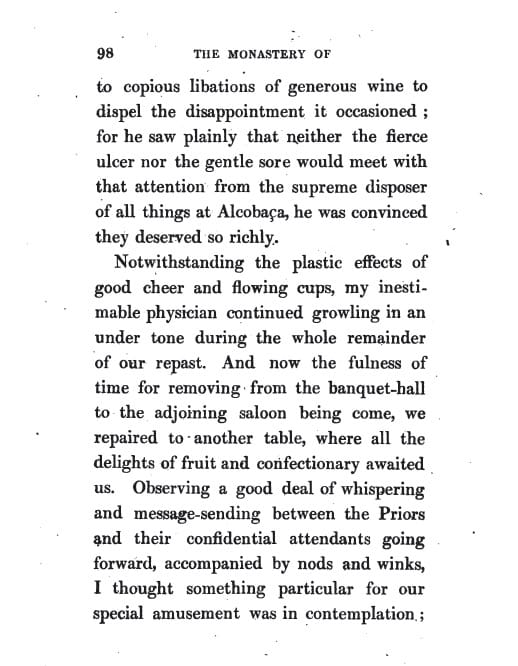




Dando-me conta de um intenso cochichar e de troca de recados entre os priores e os seus serviçais de confiança, acompanhados de acenos de cabeça e de piscadelas de olho, apercebi-me de que qualquer coisa de especial estava a ser prearada para o nosso entretenimento
e não me enganei: em breve se desfez o mistério com a entrada de uma figura alta, pálida, de nariz adunco, metido numa coçada indumentária de corte, que avançava com passos medidos, dando, com uma mão, pancadinhas lentas e solenes num rolo de pergaminho que trazia na outra.
Não consegui perceber que tipo de diploma ou documento iria ser desenrolado, quando a tal figura fazendo rodá-lo com os dedos em forma de garras o estendeu deixando perceber a forma de um cartaz de teatro, com umas flamejantes letras a vermelho e dourado. No rolo li com toda a clareza que naquela noite, pela graça de Deus e especial permissão do Abade de Alcobaça, grande Esmoler de Portugal, etc., etc., etc., seria encenada a execrável tragédia de Dona Inês de Castro e o cruel assassinato da bela dama e das suas
duas inocentes crianças reais, representada no palco; o papel de Dona Inês pelo senhor Agostinho José.
“O assassinato dos dois infantes reais!” exclamei eu, “que quer isto dizer? sabemos muito bem infelizmente, como se viram livres de Dona Inês, mas as suas duas queridas criancinhas escaparam das garras do tirano – não foi assim, meu bom Senhor Abade?”
“Assim foi, na verdade”, respondeu sua reverência, “mas este belo drama não é da produção de nenhum dos nossos bardos nacionais – um cavalheiro italiano que nos dá a honra de usufruir da nossa hospitalidade há vários anos, e que já domina na perfeição a nossa língua, é o autor e, sendo estrangeiro, não se lhe pode pedir que nutra por aquelas preciosas crianças o mesmo sentimento que nós, Portugueses. Pediu-me, pois, a minha autorização para os matar, com vista a aumentar o efeito da catástrofe. A fim de não melindrar pessoa de tão transcendentes aptidões e meu amigo
particular, consenti. Ainda pensou em fazê-los perecer pela mão da própria mãe num ataque frenético, mas não pude consentir nisso, seria esticar a corda um bocadinho demais – não acha?
Lembrando-me das cordas esticadas com que me deparava frequentemente nos romances históricos do meu país – veja-se o “recess” de Miss Lee e muitos outros – não levantei objecções e, virando-me para o bardo que estava de pé, envolto em pensamentos de futuros assasínios, louvei-lhe a sublime incursão na veia trágica – a terrible via – nos mais entusiásticos termos que pude encontrar. Animado por estes gratos elogios, vociferou com uma tremenda veemência: “Deixem-me viver mais alguns anos e darei a morte de metade das personagens reais da História de Portugal, à minha maneira. Hei-de colocá-los magníficos nos campos de batalha, apesar de terem morrido entre os brocados dos leitos, rodeados pelo pranto
dos cortesãos; hei-de afundá-los no oceano, embora tenham falecido em terra seca; - serão horrendas as suas agonias no afogamento; não, mais ainda, hei-de convocar o Príncipe daas Trevas e até o próprio Lúcifer para que os levem vítimas dum qualquer pecado ou pacto secreto, apesar de terem gasto muitas orações nas igrejas para se protegerem de tais calamidadaes ameaçadores.
Pensei que esta corda se esticara com uma vingança. O abade, como percebi pela sua anuência, era da mesma opinião, mas, com um demorado encolher de ombros, pois o bardo gozava de um favoritismo especial, contentou-se com murmurar-me ao ouvido: “Sta doëdo – sta doëdo, o homem é doido – como todos os poetas”.
O Prior Mor de Avis, que me pareceu não duvidar da verdade desta afirnação, no caso vertente, fixou os olhos no bardo com uma expressão de alarme quase ridícula e, encolhendo-se na cadeira, exclamou piedosamente:
“Como? Dona Inês e os filhinhos retalhados em palco? Nunca o suportarei, os meus olhos jorrariam como fontes,
e ultimamente já tivemos choro que chegue” (aludindo, talvez, à `cena de liquefacção da noite anterior). “tragédias de um tão profundo colorido, como esta promete ser, afectam os meus nervos de uma maneira bastante dolorosa”. Dito isto, retirou-se sem mais cerimónia, acompanhado de dois reverendos padres, dignitários do convento, que professavam da mesma aversão clerical a cenas de derramaneto de sangue.
Assim que nos deixaram para irem jogar uma partida de voltarete no conforto dos seus aposentos, Lord Abbot, observando que se fazia tarde (pois não nos tínhamos dado conta do tempo considerável que estivéramos à mesa) convidou-me para ir apreciar, sob a orientação do sub-prior, um teatro que tinha sido temporariamente instalado na ponta mais distante do imenso edifício de cuja extensão, bem como da imensa variedade de
claustros, celas, capelas e câmaras, não tinha tido ainda uma ideia exacta. As nossas peregrinações não foram, pois, pequenas nem pouco intricadas. Atravessámos diversas galerias mal iluminadas, perturbando,receio bem, as devoções de alguns monges idosos a uma imagem de Nossa Senhora das Dores, colocada sob um dossel de veludo roxo, sumptuosamente arrebicado.
Mais à frente, um outro vasto corredor partia para o lado do convento destinado a estudantes e noviços. Não eram poucos os jovens que queriam progredir no manejo da órgão, dedilhando muito eficientemente. Todos deslizaram dali para fora assim que nos aproximámos – o grupo deveria estar em grandes rambóias, suspeito eu, pelo seu ar corado e desalinhado – desejando que fôssemos, atrevo-me a dizê-lo, para o purgatório ou
um sítio pior por termos interrompido a sua recreação.
Avançando com a gravidade devida, transpusémos as umbreiras de uma porta de arquitectura imponente, com uma pomposa inscrição no frontão em caracteres de dourados e entrámos num extraordinariamente espaçoso salão que parecia ter sido designado para fins mais santos, pois havia um órgão incrustrado numa das paredes laterais. Na parede do fundo havia uma imensa cortina verde com as insígnias do convento em cores vivas; no centro do salão estavam, como era de esperar com várias filas de bancos de carvalho polido; mas o que não esperava encontrar era uma reunião de cerca de cem padres veneráveis, sentados em filas solenes, como se estivessem a num concílio ecuménico, alguns limpando os óculos e outros desfiando os
Perguntava-me o que poderia fazer retardar a representação, quando chegaram até nós uns sons semelhantes aos que emana um galinheiro em revolução. A voz de Franchi sobrepunha-se às outras, e vim a saber mais tarde que tinha tentado, sem sucesso, persuadir D. Inês (um dos papalvos mais desajeitados que já encontrei) a renunciar a um enorme par de brincos que tilintavam barulhentamente e a trazer uma cauda majestosa na qual tropeçava a cada passo, análoga às que estão na moda nas rainhas de tragédia no Teatro do Salitre. Tudo o que parecia uma crítica inspirada pela capital feria tão profundamente o amor-próprio do adolescente provincial, que ele ameaçava ter uma crise de nervos e queixar-se ao Senhor Abade. Isto foi decisivo, e Franchi cedeu: Dona Inês conservou os seus vestidos e os brincos, e o pano subiu.
Eis que Sua Reverência me murmura à orelha,
por cima do braço da minha cadeira: Se tivésseis ouvido Agostinho declamar há duas semanas, teríeis ficado encantado - as suas inflexões eram tão comoventes, tão patéticas! A sua voz está agora um pouco rouca mas vós, que tendes um bom ouvido, reconhecereis rapidamente que ele está a tornar-se um magnífico barítono; e quanto à interpretação, estou convencido que em breve confessareis que nunca existiu nada mais sublime.
Na altura em que ia responder a este panegírico dum modo não menos elogioso, o Senhor Abade murmurou docemente: Chiu! Chiu! Não ouvis Dona Inês? Certamente, eu ouvia-a, e sem dificuldade, pois jamais rainha de algum estábulo soltou semelhante mugido. Jamais uma vaca, à qual se acabasse de tirar o último vitelo parido, emitiu sons mais lamentáveis: estes tornaram-se cada vez mais lúgubres até ao momento em que a infeliz menina, avançando para as luzes da ribalta, gritou: Cruel, Cruel!,dirigindo-se assim, supondo, à sombra do seu temível sogro - querias matar os meus inocentes? Conseguiste descobrir o meu calmo refúgio? Para onde fugir? Para onde correr?