- Sumário
- Comentário de Nathaniel William Wraxall sobre as características do Teatro Português (1772)
- Ano
- 1772
- Comentário
- Dá-se o texto da tradução de Rui Vieira Nery, pois a de Laureano Carreira é sobre a tradução francesa de 1817 e diz respeito aos dois primeiros fragmentos
- Impresso
- Nathaniel William Wraxall, Historical memoirs of my own time, London, J. M'Creery para T. Cadell & W. Davies,1815, pp. ; 18-19; 40
- Menções
- Laureano Carreira O teatro e a censura em Portugal na segunda metade do século XVIII, Lisboa, Imprensa Nacional, 1988, pp. 391-392;93-394; Rui Vieira Nery
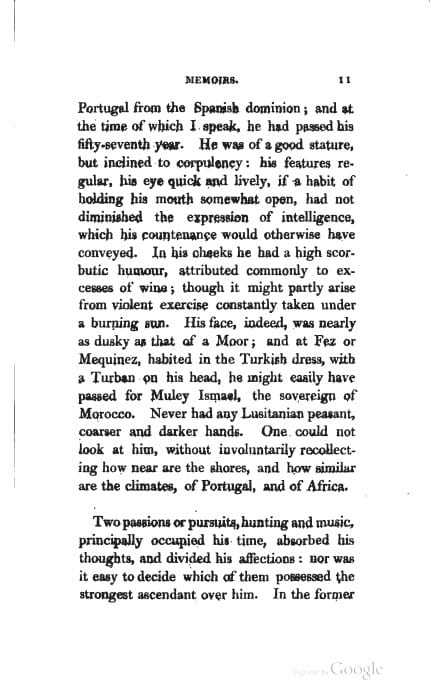
Two passions or pursuits, hunting and music, principally occupied his time, absorbed his thoughts, and divided his affections: nor was it easy to decide which of them possessed the strongest ascendant over him. In the former
diversion he passed the far greater part of the day: to the latter amusement his evenings were principally or wholly dedicated, either in public, when at the Opera; or in private, with his family. No royal house in Europe was then so musical as that of Portugal. Joseph himself performed with considerable execution on the violin; and the three Princesses, his daughters, all were proficient in a greater, or in a less degree, on different instruments. If he was prevented by the weather from going out to the chace, the King had recourse for occupation to his manege. On Sundays he seldom or never missed attending the Italian Opera in Lisbon; but he likewise maintained another Opera at Belem, his residence near the capital. I have been present at this latter performance, to which only foreign ministers, officers, persons belonging to the Court, and foreigners of condition, were admitted; all of them, gratuitously. The house itself was of very contracted dimensions; the pit not being calculated to contain more than about one hundred and thirty individuals. Boxes, indeed, in the proper acceptation of the word, there were none; the King, Queen, and Royal Family, being seated in a gallery fronting the stage, elevated considerably above the body of the house. One small box was constructed on each side; that on the right hand being appropriated to the Patriarch, or head of the Portuguese church, whom I have seen present at the performance. The other usually remained vacant, being reserved for any stranger of high rank who might visit Portugal.
The circumstance which distinguished this entertainment from any other of the same kind which I ever witnessed; and which may appear so extraordinary as hardly to obtain credit; consisted in the total exclusion of women, not only from the pit, but from the stage, either as spectators, or as actresses. No female could obtain admission. The reason commonly assigned by the Court, for proscribing the whole sex from any participation in an amusement, of which, in all other European countries, they constitute the principal ornament and the soul; was, that there were no proper places for ladies. But it might have been answered, that nothing could be easier than to construct side-boxes for their reception. Even this reason could not explain their exclusion from the stage, on which none except Italian Castrati were ever admitted to sing, or to perform any part. Battistini, who filled with great distinction the first female characters, was selected and engaged, not only for his superior vocal excellence, but for his feminine appearance, and admirable resemblance to a woman, when he was dressed in female attire. So complete indeed was the deception, that I think it never would have occurred to any uninformed person, to doubt for an instant, of his being what he personated. Even the Ballets were all performed by men or boys, habited in the Costume of nymphs, shepherdesses, and goddesses. This exclusion of all females, except the Queen and Princesses, rendered the spectacle, though otherwise magnificent in machinery and decorations, as well as scientific in point of musical execution; comparatively insipid, dull, and destitute of interest or animation. Incredible as it may seem, the passion of jealousy constituted the cause of so singular a prohibition. The Queen of Portugal, though at this time she was considerably advanced towards her sixtieth year, yet watched every motion of her husband, with all the vigilant anxiety of a young woman. And in order the better to secure his personal fidelity, she wisely took care to remove from before his eyes, as much as possible, every temptation to inconstancy. [...]
Nor was her vigilance by any means confined to the Opera. She displayed the same aprehensions, and took similar precautions, against any rival or intruder in the King's affections, whenever he went out to the chace.
No splendour or exhibition of state was maintained by the King of Portugal, who, though he scarcely ever failed to attend, with the Royal Family, every week at the Bull Feasts, and the Italian Opera in Lisbon, yet was always understood to be present incognito. The only deviation from this pratice or Etiquette, took place when the Court went annually, as was the invariable custom in time of Carnival, about the middle of january, to the Palace of Salva Terra, situated several leagues higher up the Tagus than the Metropolis. The King remained there till the month of March, and all the foreign ministers usually attended him. Hunting parties, to which strangers of condition were admitted, constituted the occupation of the day; followed in the evening by an Opera, like that of Belem, open gratuitously to all such persons as had been presented to the
Sovereign. I was assured that Joseph expended no less a sum than about forty thousand Pounds sterling annually, on the diversion of the Opera.
The Prince of Beyra, himself, eldest son of the Princess of Brazil and of Don Pedro, was then the Marcellus of Portugal; towards whom all eyes were turned, and from whose future auspicious Government, political miracles were fondly anticipated. It may excite the more surprize that such expectations should have been entertained, when I add that in 1772, he had only completed the eleventh year of his age. I have seen him many times, as he never failed to attend the Royal Family in public, at the Bull Feasts, at Church, and every where except at the Italian Opera; a diversion for which he manifested a decided aversion.
As soon as the Bull Feast ended, which was commonly about six o'clock, the King, Queen, and Royal Family immediately repaired to the Italian Opera, which was at a very inconsiderable distance, in the same quarter of Lisbon. Such was the invariable Usage or Etiquette, every Sunday. Yet, there, as at the Bull Feast, though seated in the front of the Theatre, they were supposed to preserve their Incognito. Joseph's dress, on these occasions, was always a full-trimmed suit of silk, or of cloth; either quite plain, or embroidered with white silk: the sumptuary laws of Portugal prohibiting embroidery with gold or silver. He wore a flowing tye-wig, as we see George the Second represented in his portraits; and the Portuguese Order of Christ, on his breast. The Queen and Princesses were covered with diamonds; in particular, the Princess of Brazil: but the Queen alone wore Rouge, from the use of which her daughters abstained. During the course of the performance, His Majesty never failed to go round to his private Box, close to the Stage, in order to view the Ballets, after each of which he returned to the Royal family. On these little excursions, which he always seemed to enjoy, and during which he generally made the best use of his time, with
his Opera glass, in contemplating the female part of the audience who filled the side Boxes, several noblemen accompanied him.

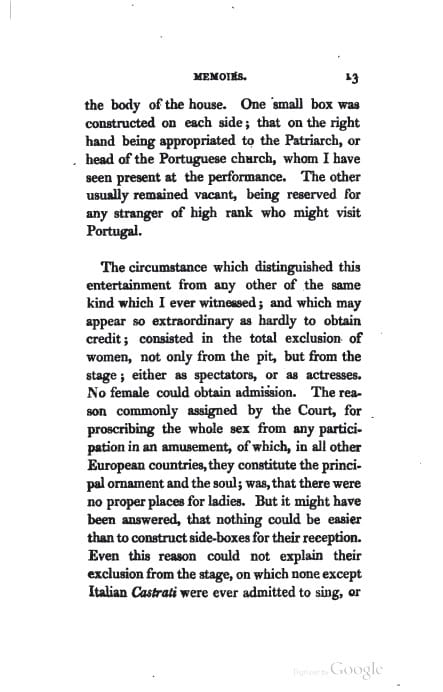
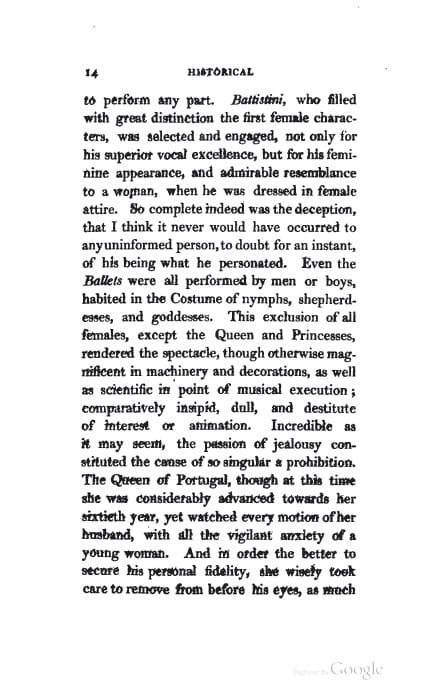

A circunstância que distinguiu este divertimento de qualquer outro do mesmo tipo a que eu tenha assistido e que pode parecer extraordinária ao ponto de dificilmente ser credível consiste na total exclusão das mulheres, não só da plateia mas também do palco, quer como espectadoras quer como actrizes. Nenhuma pessoa do sexo feminino podia ser admitida. A razão habitualmente invocada pela Corte, para proibir a todo um sexo a participação num divertimento de que, em todos os outros países da Europa, ele constitui o principal ornamento e a própria alma, era que não havia lugares adequados a Senhoras. Mas poder-se-ia responder que nada seria mais fácil do que construir camarotes laterais para as receber. Nem mesmo esta razão poderia explicar a sua exclusão do palco, onde, com excepção dos castrados italianos, nenhuma era admitida a cantar
ou a desempenhar qualquer papel. Battistini, que representava com grande distinção os personagens femininos principais, foi escolhido e contratado não só pela sua excelência vocal superior mas também pela sua aparência feminina e pela sua notável semelhança a uma mulher quando se vestia com trajes femininos. A ilusão era tão completa que penso que nunca ocorreria a qualquer pessoa não informada duvidar por um instante de que ele não fosse aquilo que personificava. Até os próprios bailados eram todos eles executados por homens ou rapazes, vestidos de ninfas, pastoras e deusas. Esta exclusão de todas as pessoas do sexo feminino excepto a Rainha e as Princesas tornava o espectáculo, apesar de em todos os restantes aspectos ser magnífico no que respeita à maquinaria e aos cenários, bem como rigoroso do ponto de vista da execução musical, comparativamente insípido, enfadonho e desprovido de interesse ou de animação. Por mais incrível que pareça, a causa de tão singular proibição estava na paixão do ciúme. A Rainha de Portugal, apesar de ao tempo já estar consideravelmente perto dos sessenta anos, seguia todos os movimentos do marido com toda a ansiedade vigilante de uma mulher mais jovem. E, de maneira a melhor garantir a fidelidade pessoal do Soberano, teve o cuidado sábio de remover da vista deste, tanto
quanto possível, qualquer tentação que pudesse levar à inconstância. [...]Nem a sua vigilância se confinava, de modo algum, à Ópera. Demonstrava as mesmas apreensões e tomava precauções semelhantes contra qualquer rival ou intrusa nos afectos do Rei sempre que este ia à caça.
O Rei de Portugal não se fazia rodear de qualquer pompa ou ostentação do seu estatuto, pelo que, embora raramente deixasse de assistir todas as semanas, com a Família Real, às touradas e à Ópera italiana, em Lisboa, se considerava sempre que o fazia incógnito. O único desvio deste uso, ou etiqueta, tinha lugar quando a Corte ia anualmente, como era seu costume invariável na época do Carnaval, por volta de meados de Janeiro, para o Palácio de Salvaterra, situado várias léguas a Norte da metrópole, subindo o Tejo. O Rei permanecia aí até meados de Março e todos os ministros estrangeiros costumavam ficar com ele. A ocupação quotidiana era constituida por caçadas a que eram admitidos os estrangeiros de condição e às quais se seguiam, ao serão, espectáculos de Ópera, como os de Belém, abertos gratuitamente a todas as pessoas que tinham sido apresentadas ao
Soberano. Foi-me garantido que D. José não gastava menos de quarenta mil libras esterlinas por ano na diversão da Ópera.
Quanto ao próprio Príncipe da Beira, filho mais velho da Princesa do Brasil e de D. Pedro, era o Marcelo de Portugal, em quem todos tinham os olhos postos e de cujo auspicioso governo futuro se esperavam com alegria milagres políticos. Pode causar ainda mais surpresa que tais esperanças fossem assim alimentadas se eu acrescentar que em 1772 ele tinha acabado de completar onze anos de idade. Vi-o muitas vezes, visto que ele nunca deixava de aparecer em público com a Família Real quando esta ia à tourada, à igreja ou a qualquer lado com excepção da Ópera italiana, divertimento pelo qual manifestava uma decidida aversão.
Assim que a tourada acabava, o que
acontecia habitualmente por volta das seis, o Rei, a Rainha e a Família Real partiam imediatamente para a Ópera italiana, que ficava a uma distância irrelevante, no mesmo bairro de Lisboa. Tal era o uso ou etiqueta invariável de todos os Domingos. Contudo, tanto aí como na tourada, apesar de estarem sentados na frente do Teatro, considerava-se que o faziam incógnitos. O traje de D. José, nestas ocasiões, era sempre um fato completo de seda ou de pano, ou muito simples ou bordado a seda branca, já que as leis sumptuárias de Portugal proíbem o bordado a ouro ou a prata. Usava uma peruca solta, de atar, daquelas com que vemos Jorge II [de Inglaterra] representado nos retratos, e a Ordem portuguesa de Cristo no peito. A Rainha e as Princesas estavam cobertas de diamantes, em especial a Princesa do Brasil, mas só a Rainha se vestia de vermelho, uso de que as filhas se abstinham. Durante o espectáculo Sua Majestade nunca deixava de ir à volta até ao seu camarote privado, perto do palco, de forma a ver os bailados, regressando após cada um deles para junto da Família Real. Nestas pequenas excursões, de que parecia sempre gostar muito e durante as quais fazia em geral bom uso do seu tempo contemplando com
os binóculos de Ópera a parte feminina do público que enchia os camarotes laterais, era acompanhado por vários fidalgos.