- Sumário
- Comentário de James Murphy sobre a representação de uma peça sobre Inês de Castro (1789)
- Ano
- 1789
- Comentário
- A tradução é de Rui Vieira Nery
- Impresso
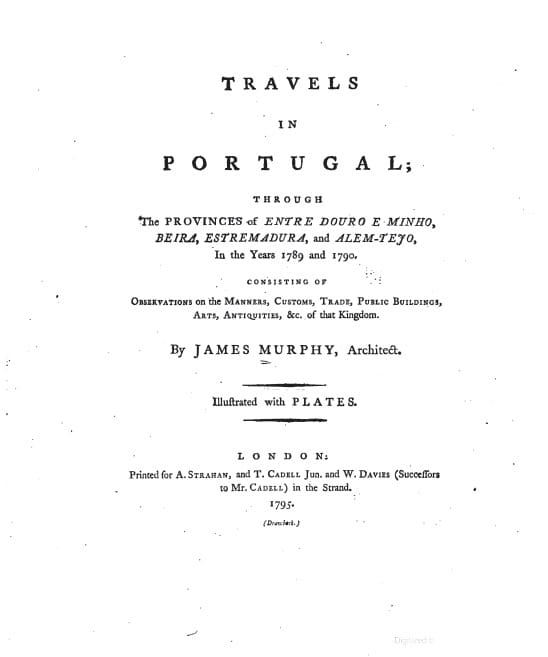
- James Murphy Travels in Portugal through the Provinces of Entre Douro e Minho, Beira, Estremadura and Alem-tejo in the years 1789 and 1790, London, A. Strahan, and T. Cadell Jun. and W. Davies, 1795, pp. 158-159
- Menções
- Laureano Carreira, O teatro e a censura em Portugal na segunda metade do século XVIII, Lisboa, Imprensa Nacional, 1988, pp. 403-404; Rui Vieira Nery
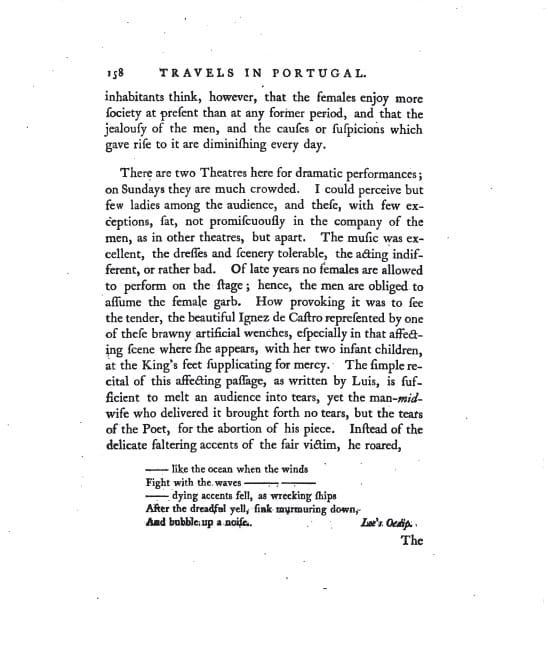
There are two theatres here for dramatic performances; on sundays they are much crowded. I could percieve but few ladies among the audience, and these, with few exceptions, sat, not promiscuously in the company of the men, as in other theatres, but apart. The music was excellent, the dresses and scenery tolerable, the acting indifferent, or rather bad. Of late years no females are allowed to perform on the stage; hence, the men are obliged to assume the female garb. How provoking it was to see the tender, the beatiful Ignez de Castro represented by one of these brawny artificial wenches, especially in that affecting scene where she appears, with her two infant children, at the King's feet supplicating for mercy. The simple recital of this affecting passage, as written by Luis, is sufficiant to melt an audience into tears, yet the man-mid-wife who delivered it brought forth no tears, but the tears of the Poet, for the abortion of his piece. Instead of the delicate saltering accents of the fair victim, he roared,
--- like the ocean when the winds
Fight wih the waves --- -----
---dying accents fell, as wrecking ships
After the dreadful yell, sink murmuring down
And bubble up a noise
Lee's Oedipus
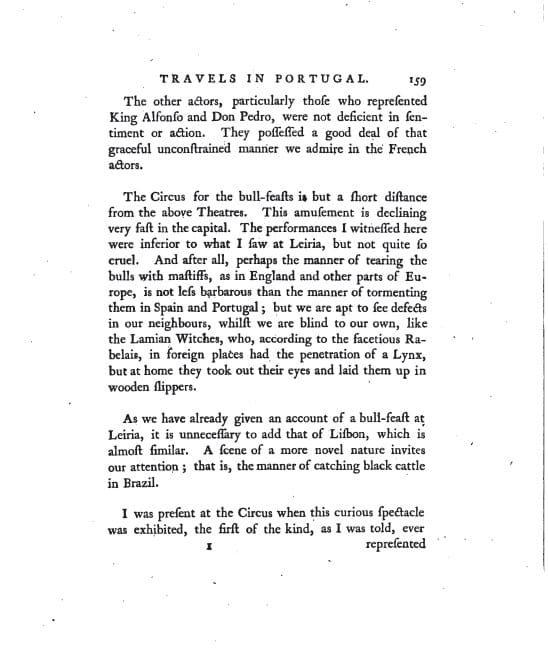
The other actors, particulary those who represented King Alfonso and Don Pedro, were not deficient in sentiment or action. They possessed a good deal of that graceful manner we admire in the French actors.
... como o oceano quando os ventos
Lutam contra as ondas ...
... soltaram-se sons de agonia, como os de navios que naufragam,
E depois de um grito terrível, se afundam num murmúrio
E soltam um ruído borbulhante.
Lee - Édipo
Os outros actores, em particular os que representavam os papéis do Rei Afonso e de Dom Pedro, não se mostraram deficientes no sentimento e na acção. Possuíam em grande medida a graciosidade que admiramos nos actores franceses.